
812 Campus Placements - 2026 :
720 Campus Placements - 2025 :
The Cloud Computing & Enterprise Platforms competency-building programs offered by the Competency Building and Consultancy (CBC) Centre equip students with industry-relevant knowledge and practical skills in Salesforce Ecosystem, ServiceNow, and Microsoft Azure. Through hands-on laboratories, real-world projects, and industry-aligned learning, students develop competencies in cloud computing, enterprise platforms, workflow automation, IT service management, security, analytics, and digital transformation. The programs emphasize experiential learning and globally recognized certification pathways, enabling students to design, deploy, manage, and optimize cloud-based enterprise solutions. These competency-building programs enhance employability and prepare students for successful careers in cloud computing, enterprise platforms, and digital transformation across diverse industries.
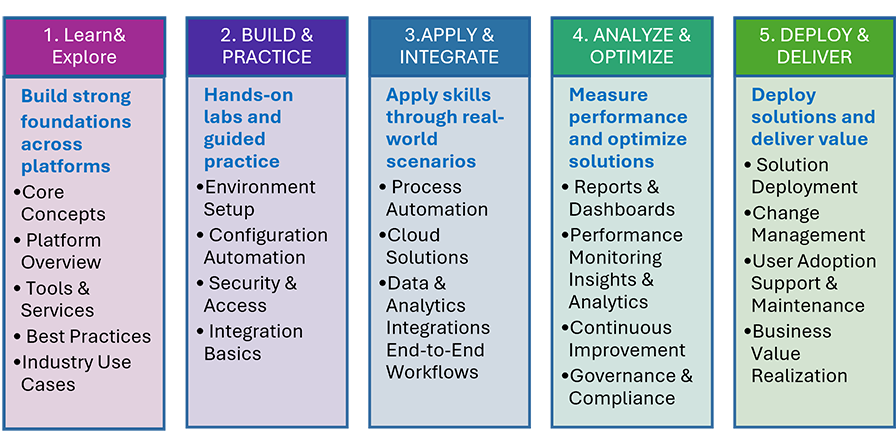
Structured competency-building journey in Cloud Computing & Enterprise Platforms as shown in figure1 highlighting the progressive learning process.
The purpose of Salesforce Ecosystem & Admin Cloud is to enable students to manage customer relationships, automate business processes, administer cloud applications, and develop CRM solutions using the Salesforce platform. It provides industry-relevant skills in cloud computing, customer engagement, workflow automation, security management, and data-driven decision making.
The curriculum is designed to provide comprehensive knowledge and practical skills in Salesforce administration, cloud platform management, automation, security, customization, and analytics. Through a structured, hands-on learning approach, students gain the competencies required to effectively configure, manage, and optimize Salesforce solutions for real-world business environments.
Topics Covered
| Salesforce Fundamentals: | Introduction to Salesforce CRM, ecosystem overview, cloud architecture, Salesforce terminology, Sales Cloud, Service Cloud, Marketing Cloud, and business applications. |
|---|---|
| Setup & Configuration: | Salesforce environment setup, user interface customization, user management, profiles, organizational settings, and platform configuration. |
| Data Management & Security: | Data models, objects, fields, records, relationships, data quality management, access control, permissions, sharing rules, and authentication mechanisms. |
| Automation & Customization: | Creating custom objects, validation rules, formula fields, workflow automation, process automation, Flow Builder, custom applications, and business process optimization. |
| Reports, Dashboards & Lightning Experience: | Building reports and dashboards, Lightning App Builder, Lightning Experience customization, analytics, and business intelligence for decision-making. |
Tools you learn: A structured overview of the Salesforce Admin Cloud ecosystem by categorizing its core tools and technologies as shown in below
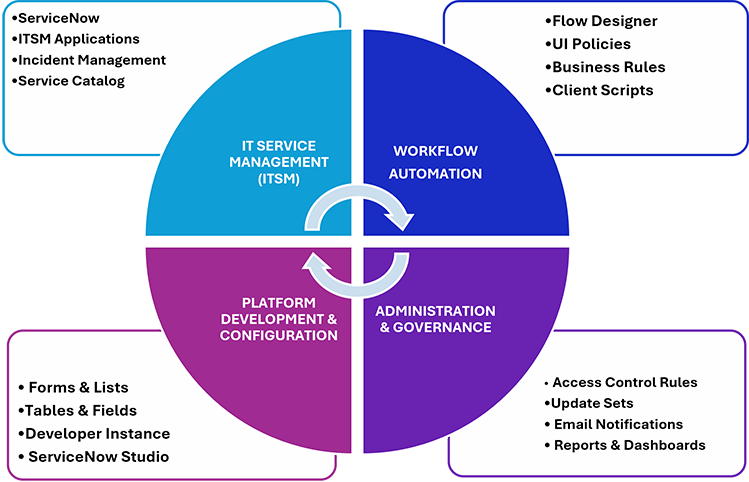
The Salesforce Admin Cloud ecosystem provides a comprehensive suite of CRM, cloud services, automation, analytics, security, customization, and learning tools for efficient business process management and digital transformation.
Salesforce CRM Core Skills Matrix
| Salesforce CRM | Sales Cloud | Service Cloud | Marketing Cloud |
| Salesforce Lightning | Flow Builder | Process Builder | Workflow Rules |
| Reports & Dashboards | Validation Rules | Permission Sets | Role Hierarchy |
| Sharing Rules | App Builder | Trailhead | Salesforce Sandbox |
Career Opportunities
The objective of the ServiceNow Platform & IT Service Management (ITSM) program is to enable students to manage enterprise services, automate digital workflows, administer cloud-based applications, and develop efficient IT service solutions using this platform. It provides industry-relevant skills in IT service management, incident management, platform customization, security administration, and business process optimization.
The curriculum provides a strong foundation in enterprise service management principles, enabling students to understand and implement industry best practices for incident, problem, change, and service request management. Through laboratory exercises, real-world case studies, and project-based learning, students develop practical competencies in workflow design, platform configuration, security administration, reporting, and application customization.
Topics Covered
| ServiceNow Fundamentals: | Introduction to ServiceNow, platform architecture, cloud computing concepts, multi-tenant environment, developer instances, applications, modules, and business use cases. |
|---|---|
| Platform Basics & Administration: | Applications, modules, forms, lists, tables, user management, group creation, role assignment, and access control mechanisms. |
| Data Management & Configuration: | Field creation, sections, views, table management, form customization, and data organization. |
| Incident Management: | Incident lifecycle, incident creation, assignment, escalation, resolution processes, and best practices in IT service management. |
| Reports, Dashboards & Service Catalogs: | Creation and sharing of reports, dashboard customization, homepage development, service catalog creation, and request management. |
| Automation & Notifications: | Client Scripts, UI Policies, Business Rules, email notifications, workflow automation, and process optimization. |
| Update Sets & Deployment: | Local update sets, retrieved update sets, merge operations, change migration, and deployment management. |
| Advanced Customization: | OnLoad, OnChange, OnSubmit, OnCellEdit scripting, Business Rules (Before, After, Async, Display), and application enhancement techniques. |
Tools you learn: Overview of the ServiceNow platform by illustrating its core knowledge and skill areas, including IT Service Management (ITSM), workflow automation, platform development and configuration, and administration and governance
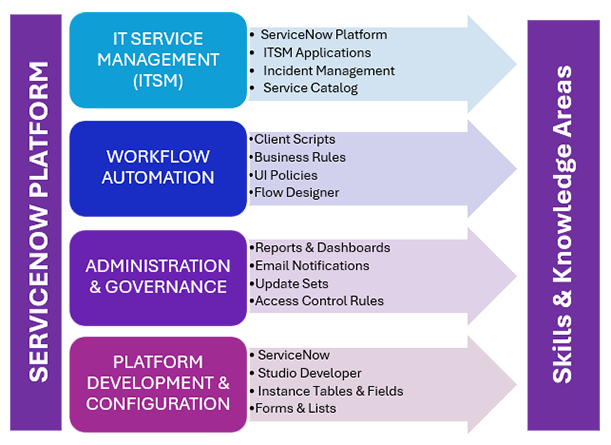
The ServiceNow platform provides a comprehensive suite of IT Service Management (ITSM), workflow automation, platform administration, reporting, application development, and configuration tools that enable organizations to streamline service delivery, automate business processes, and efficiently manage enterprise operationsThe ServiceNow platform provides a comprehensive suite of IT Service Management (ITSM), workflow automation, platform administration, reporting, application development, and configuration tools that enable organizations to streamline service delivery, automate business processes, and efficiently manage enterprise operations as below
ServiceNow Administrator Core Skills Matrix
| ServiceNow Platform | ITSM Applications | Incident Management | Service Catalog |
| Client Scripts | Business Rules | UI Policies | Flow Designer |
| Reports & Dashboards | Email Notifications | Update Sets | Access Control Rules |
| Forms & Lists | Tables & Fields | Developer Instance | ServiceNow Studio |
Career Opportunities:
The aim of Microsoft Azure is to provide students with comprehensive knowledge of cloud computing concepts and Azure services for building, deploying, and managing scalable cloud solutions. The program develops practical skills in cloud infrastructure, networking, security, storage, databases, resource management, and cost optimization using this platform.
The Microsoft Azure curriculum introduces students to cloud computing concepts and Microsoft Azure services for designing, deploying, and managing secure cloud-based solutions. The program provides hands-on experience in Azure Virtual Machines, Networking, Storage, Identity and Access Management, Databases, AI services, DevOps, and cloud security. By integrating practical laboratory sessions with industry best practices, the program enables students to build cloud-native solutions, earn globally recognized Microsoft certifications, and pursue careers in cloud engineering, cloud administration, and digital infrastructure management.
Topics Covered
| Azure Fundamentals: | Introduction to cloud computing, Azure ecosystem, Azure account creation, Azure Portal overview, Azure CLI, and Azure service categories. |
|---|---|
| Cloud Concepts: | Cloud computing models (IaaS, PaaS, SaaS), deployment models (Public, Private, Hybrid), benefits of cloud computing, and shared responsibility model. |
| Core Azure Services: | Understanding Azure compute, storage, networking, and database services for building scalable cloud applications. |
| Security, Privacy & Compliance: | Azure security tools and features, data privacy, protection mechanisms, compliance standards, trust, and transparency. |
| Azure Pricing & Support: | Azure pricing models, cost management, support plans, and Service Level Agreements (SLAs). |
Tools you learn: The key knowledge areas of Microsoft Azure, highlighting the essential tools and services required for cloud administration, infrastructure management, security, monitoring, and enterprise solution deployment as below
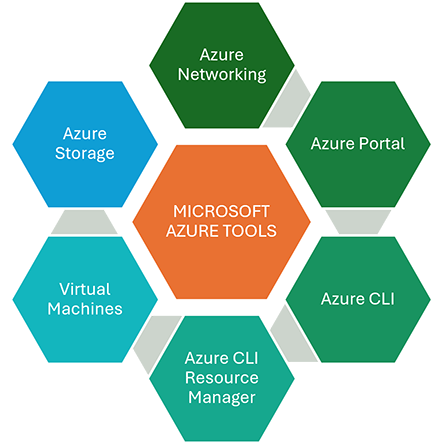
The Microsoft Azure competency-building program provides students with comprehensive knowledge of Azure cloud services, administration, infrastructure management, networking, storage, databases, security, monitoring, and cost optimization tools as below
Microsoft Azure Core Skills Matrix
| Microsoft Azure | Azure Portal | Azure CLI | Azure CLI |
| Resource Manager | Virtual Machines | Azure Storage | Azure Networking |
| SQL Database | Security Center | Azure Monitor | Cost Management |
| Active Directory | Advisor | Support Plans |
Career Opportunities:








 Work with Us
 Campus Map
 How to Reach Us
 Online Degree Verification
 IARE Mail
 Photo Gallery
 Virtual Tour