Follow the Path to Success in Electrical and Electronics Engineering
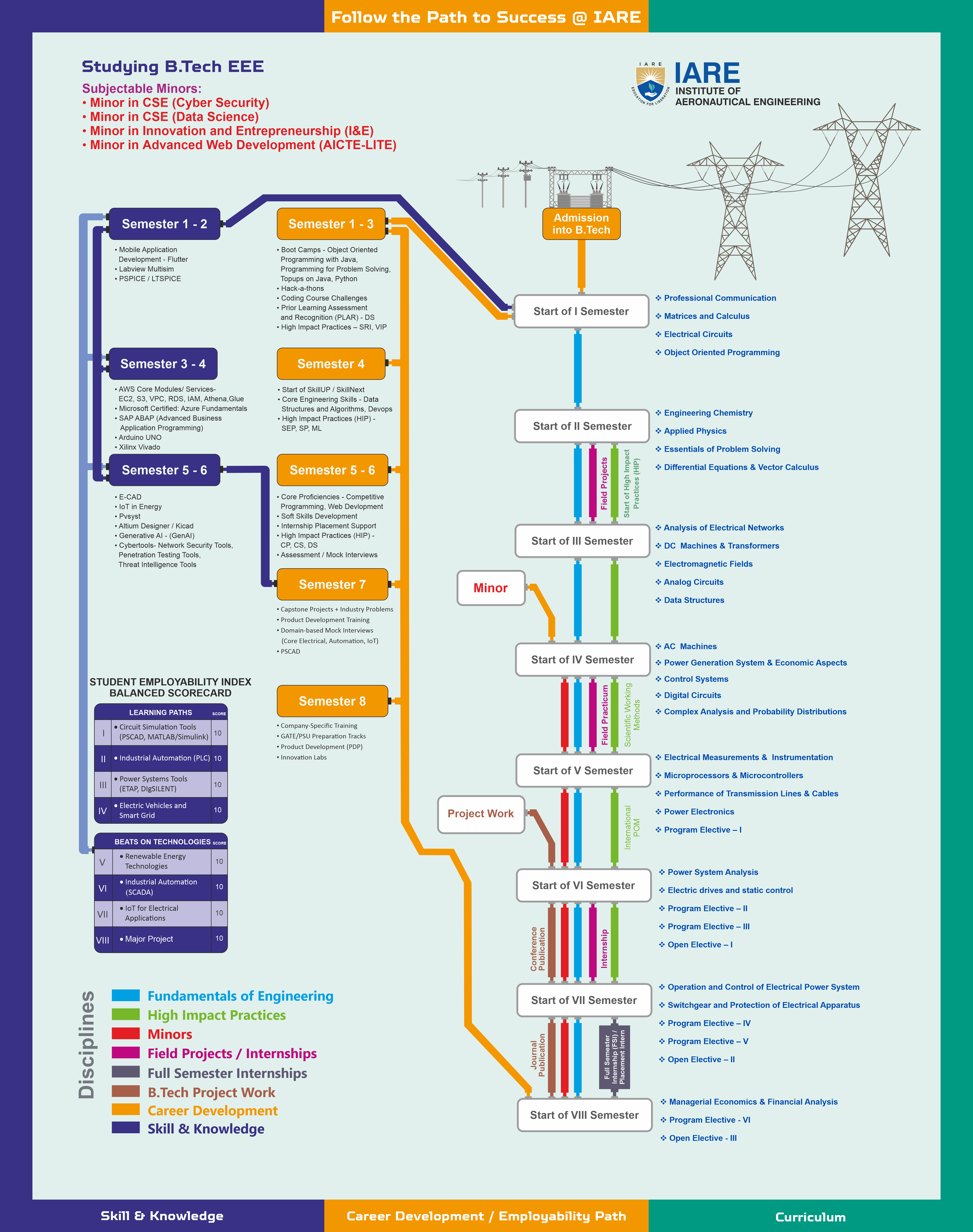
At IARE, students follow three key pathways to success: curriculum, career development, and skills and knowledge enhancement.
The B.Tech program in Electrical and Electronics Engineering combines a strong foundation in electrical and electronic systems with modern educational strategies, including project-based learning and interdisciplinary integration. Students gain hands-on experience and exposure to cutting-edge technologies through minor specializations, ensuring they graduate with a versatile and industry relevant profile.
The Most Promising Minor Program tracks along with B.Tech Degree:
- A major is a primary focus of study, typically 160 credits.
- A minor is a secondary focus of study, typically 18 credits.
Specialize in one of the minor programs relevant for the future of engineering
- 1. Power and Energy Systems
- 2. Control and Automation
- 3. Space Technology
- 4. Artificial Intelligence
- 5. Innovation and Entrepreneurship
1. Power and Energy Systems
Power and energy systems form the backbone of modern infrastructure, demanding strong analytical skills and an understanding of large-scale interconnected networks. This minor program introduces students to power generation, transmission, distribution, and utilization, with emphasis on renewable energy integration and smart grid technologies. The curriculum covers power system analysis, protection, power quality, energy storage, and modern energy management systems. Through analytical studies and simulation-based projects, students develop the technical expertise required to design, operate, and optimize reliable and sustainable power systems for utility, industrial, and emerging energy applications.
2. Control and Automation
Control and automation represent a critical domain in modern industrial and power system operations, requiring system-level modelling and real-time decision-making. This minor program provides foundational knowledge in control theory, industrial automation, and intelligent control systems. Key areas include classical and modern control, PLC and SCADA systems, industrial instrumentation, and process automation. Through hands-on experiments and simulation-driven projects, students gain practical skills to design, analyse, and implement automated solutions for industrial processes, power plants, and smart manufacturing environments.
3. Space Technology
Space technology represents a rapidly advancing frontier, requiring multidisciplinary expertise and systems-level thinking. This minor program introduces students to the fundamentals of spacecraft systems, satellite technology, orbital mechanics, launch vehicle engineering, and space environment effects. The curriculum also covers emerging areas such as small satellites (CubeSats), space propulsion, thermal control systems, and space mission planning. Through analytical studies and simulation-based projects, students develop the technical competence and problem-solving skills necessary to contribute to space missions, satellite development programs, and space research organizations, positioning them for impactful careers in the growing global space sector.
4. Artificial Intelligence
Artificial Intelligence (AI) is set to transform Electrical and Electronics Engineering by enabling intelligent power systems, smart grids, advanced automation, and predictive maintenance. This minor program enables students to master AI applications specific to the electrical domain, including smart energy management, AI-based fault detection, intelligent motor control, renewable energy forecasting, and real-time power system monitoring. The curriculum covers key topics such as machine learning, neural networks, deep learning, IoT in electrical systems, and intelligent control programming, preparing students to lead in the development of smart and sustainable electrical technologies.
5. Innovation and Entrepreneurship
The aerospace industry thrives on innovation, from breakthrough aircraft designs to space exploration technologies. This minor track prepares students to turn technical ideas into successful aerospace start-ups or innovative ventures. The program includes courses on:
- The Foundations of Entrepreneurship
- Driving Innovation in Organisations
- Applied Entrepreneurship
- Entrepreneurship and Global Challenges
Students gain practical skills in leadership, financial planning, and venture creation, enabling them to become visionary leaders in the aerospace industry.
IIARE Services for Career Development in Electrical and Electronics Engineering
We empower students to gain their first professional work experience and build sustainable engineering careers.
The Career Development Division at IARE is committed to enhancing the employability of Electrical and Electronics Engineering students by equipping them with industry-relevant technical competencies and professional skills. Through structured initiatives such as Skill Next, Skill Bridge and Skill Up, students are prepared to meet the evolving demands of the power, energy, automation and digital engineering sectors.
Practical Training
Specialized boot camps and hands-on training programs are conducted using industry-standard electrical and simulation tools such as MATLAB/Simulink, PSCAD, ETAP, PSpice, PowerWorld, AutoCAD Electrical, PLC programming platforms, and SCADA systems. Students actively participate in national-level technical competitions, innovation challenges and hackathons related to power systems, renewable energy, electric vehicles, robotics and automation, enabling real-world application of theoretical concepts.
Techniques to Build a Professional Portfolio
Students are guided to develop strong professional profiles on platforms such as LinkedIn, GitHub, and technical repositories, showcasing simulation models, automation projects, embedded system designs, and power system case studies that demonstrate their analytical and practical expertise.
Personal Career Guidance
Personalized one-on-one mentoring supports students in identifying suitable career pathways in power generation and utilities, renewable energy systems, electric vehicles, industrial automation, embedded systems, smart grids, R&D, and consulting. Guidance is also provided for pursuing industry-recognized certifications in areas such as PLC & SCADA, Power System Protection, Renewable Energy, Electric Mobility, Embedded Systems, Industrial Automation and Industry 4.0, ensuring long-term professional growth.
Online Events and Trainings
Structured Prior Learning Assessments (PLA) are conducted in core EEE subjects such as Electrical Machines, Power Systems, Power Electronics, Control Systems, Signals and Systems, and Network Theory. Students strengthen programming and analytical skills through MATLAB, Python, and simulation-based workshops, along with virtual training on advanced topics including Smart Grids, Energy Storage Systems, Electric Vehicles, IoT for Power Systems and AI-based Electrical Applications.
Finish Strong with Us!
Final-year students receive focused preparation for industry roles through advanced technical training, competitive aptitude development, technical documentation, and capstone project execution. Hands-on exposure is provided through industry-oriented power system studies, automation projects, EV subsystem design, renewable energy simulations and real-time control applications.
Supplementary Studies
High-impact learning opportunities are offered through industrial internships, applied research projects, innovation-based assignments, and professional certifications in emerging domains such as Electric and Hybrid Vehicles, Renewable Energy Systems, Smart Grid Technologies, Power Electronics, Automation and Control and AI-driven Energy Systems.
Integration, Career Support and Networking
Strong industry–academia collaboration is fostered with organizations such as NTPC, Power Grid Corporation of India, ISRO, DRDO, BHEL, and leading renewable energy and automation companies. Students engage in technical clubs, conferences, workshops, and student chapters of professional bodies such as IEEE, IET, and ISTE, promoting long-term professional networking and growth.
IARE Focus on In-Demand Careers in Electrical Engineering
Career planning begins during the academic journey - IARE provides continuous support.
The Competency Building and Consultancy Division at IARE offers a comprehensive ecosystem for career planning and professional development of EEE students, ensuring alignment with rapidly evolving electrical and energy sectors.
Mid-Career Consortium
Focused preparation is provided in advanced domains such as Power System Analysis, Renewable Energy Integration, Electric Vehicles, Power Electronics, Industrial Automation, Smart Grids and Energy Management Systems. Training includes hands-on exposure to MATLAB/Simulink, ETAP, PSCAD, PLC & SCADA platforms and power electronics simulation tools, aligned with industry needs.
Career Monitoring
Student progress is tracked through a Student Employability Index, using Balanced Scorecard metrics that evaluate technical skills, project experience, certifications, and industry readiness. Periodic assessments ensure alignment with career objectives and sectoral requirements.
Special Interest Curriculum
Customized learning modules are offered in Power and Energy Systems, Electric Mobility, Automation and Control, Renewable Energy, Embedded Systems, IoT, and AI for Power Applications. Students may pursue certifications in Power System Protection, PLC & SCADA, Solar and Wind Energy Systems, EV Technology, Smart Grid Technologies and Quality Engineering.
Professional Development
Career readiness is strengthened through technical workshops, industry mentorship, simulation-based training, and project-based learning. Students are encouraged to participate in national and international competitions, innovation challenges and IEEE technical activities.
Career Advancement
Advanced technical training, professional certifications, entrepreneurship support, and industry networking enable students to pursue leadership roles in power utilities, renewable energy firms, automation industries, EV companies and R&D organizations.
Visiting Employer Programs
Industry–academia interaction is strengthened through on-campus recruitment sessions, expert lectures by industry professionals, alumni engagement, and employer-led workshops from leading electrical, energy and automation organizations.
Accelerated Courses
Fast-track career pathways include options for full-semester internships during the VII/VIII semester with reputed power utilities, renewable energy companies, automation firms and R&D organizations. Academic flexibility is provided for students receiving early job offers or internships, enabling them to gain real-world experience prior to graduation.










 Work with Us
 Campus Map
 How to Reach Us
 Online Degree Verification
 IARE Mail
 Photo Gallery
 Virtual Tour